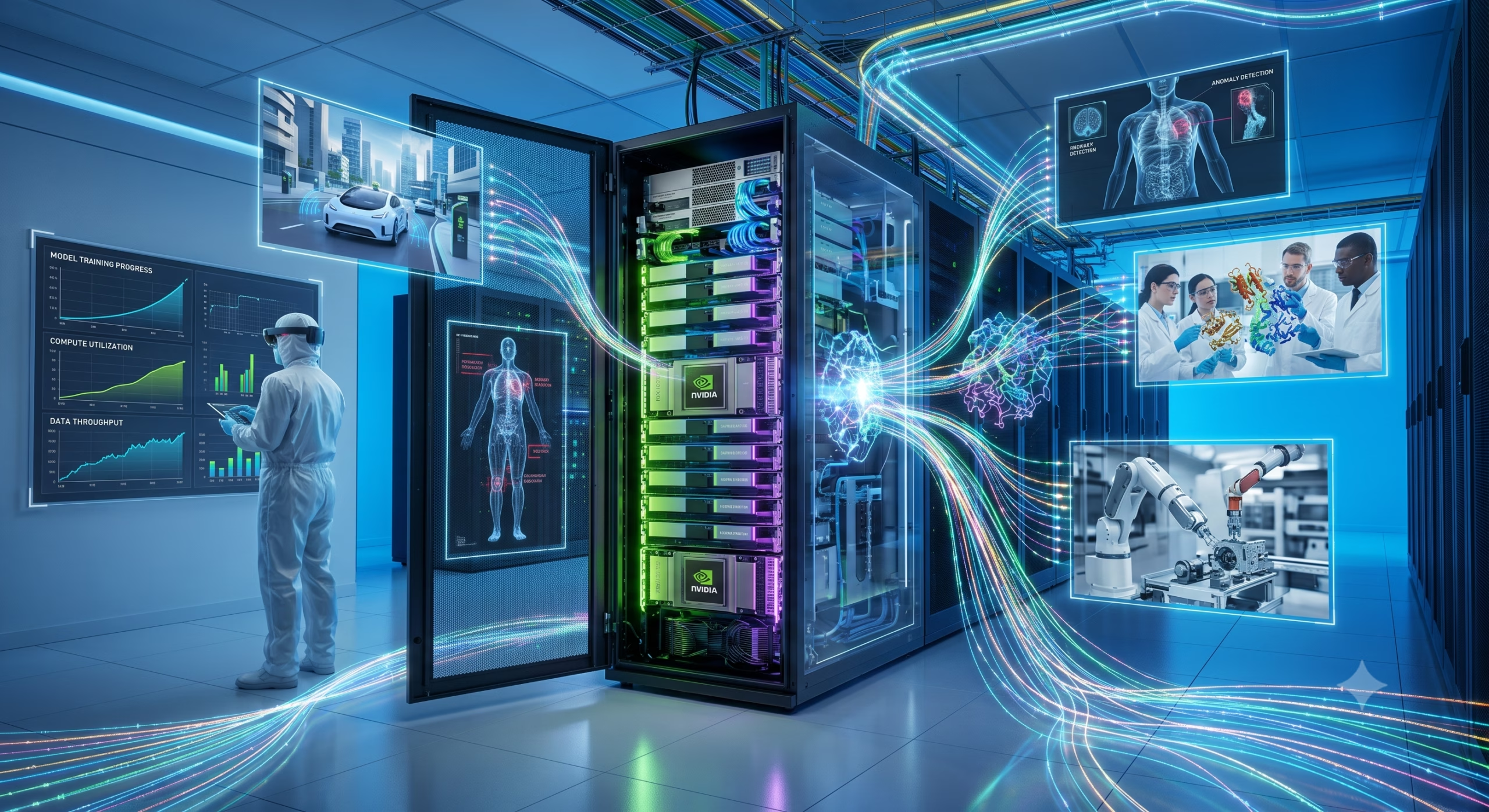
Powering the AI Revolution: Using Dedicated Hardware for Machine Learning Workloads.
Why CPUs Aren’t Enough
Central Processing Units (CPUs) are the “jacks-of-all-trades” in the computing world. They are designed to handle a wide variety of tasks sequentially. While they are essential for operating systems and basic logic, ML workloads require billions of simultaneous mathematical operations—specifically matrix multiplications and vector additions.
The Titans of ML Hardware
To meet the demands of modern neural networks, several specialized hardware architectures have emerged:
-
- Graphics Processing Units (GPUs): Originally designed for rendering video games, GPUs possess thousands of small cores optimized for parallel processing. They have become the industry standard for training deep learning models.
-
- Tensor Processing Units (TPUs): Developed by Google, TPUs are Application-Specific Integrated Circuits (ASICs) designed from the ground up strictly for machine learning. They excel at high-volume tensor operations, offering significant speedups for specific frameworks like TensorFlow.
-
- Field-Programmable Gate Arrays (FGPAs): These are unique because they can be reconfigured after manufacturing. They offer a middle ground between the flexibility of a CPU and the efficiency of an ASIC, making them ideal for specialized “edge” AI applications.
-
- Neural Processing Units (NPUs): Increasingly found in smartphones, these chips are dedicated to running AI inference locally (like Face ID or real-time photo enhancement) without draining the battery.
Training vs. Inference
When discussing hardware, it is important to distinguish between two phases of the ML lifecycle:
Training: This is the most resource-intensive phase, where a model “learns” from a massive dataset. This requires heavy-duty hardware like GPU clusters or TPU pods, often housed in giant data centers.
Inference: This is the phase where the trained model is put to use (e.g., a car identifying a pedestrian). Inference requires low latency and high energy efficiency, leading to the rise of specialized AI chips in “edge” devices like cameras and drones.
The Future: Beyond Silicon
As we push the limits of traditional silicon-based chips, the industry is looking toward radical new technologies. Neuromorphic computing aims to mimic the architecture of the human brain, while Optical (Photonic) computing uses light instead of electricity to perform calculations at lightning speeds with minimal heat.
Conclusion
The AI revolution is as much a hardware story as it is a software story. Without the massive parallel processing power of GPUs and the specialized efficiency of TPUs, the large language models and autonomous systems we see today would remain theoretical. As hardware continues to evolve, we can expect AI to become faster, more efficient, and more integrated into the fabric of our daily lives.